 Get emergency food
Safeguarding Policy and Procedures (SGP3)
Safeguarding Policy and Procedures (SGP3)
| Purpose of this Statement | To detail the Safeguarding Policy & Procedures at Craigavon Area Compassion Project/ Craigavon Area Foodbank |
| Dated | May 2026 |
| Contact | Emma Beggs – Operations Manager and Safeguarding Lead |
Contents
3. POLICY EQUALITIES STATEMENT 2
5. SCOPE AND DEFINITIONS OF THE POLICY 2
Whose Business is Safeguarding? 2
All staff and volunteers will consider the following when raising a concern: 4
8. INFORMATION SHARING AND CONSENT 5
9. CONFIDENTIALITY AND RECORDING 7
10. PROCEDURE IF A MEMBER OF STAFF OR VOLUNTEER HAS A SAFEGUARDING CONCERN: 7
12.1 Recruitment of staff and volunteers 9
13. MANAGEMENT AND SUPERVISION 10
14. ROLES AND RESPONSIBILITIES 10
Appendix 1 - Key Contacts & Foodbank Venues 12
APPENDIX 2 - SAFEGUARDING INCIDENT REPORTING FORM 14
Appendix 3 - SG Concern Flowchart 16
Appendix 4 - Signs and Symptoms of Abuse (Children) 17
APPENDIX 5 - SIGNS AND SYMPTOMS OF ABUSE (ADULTS) 18
Appendix 6 - Whistle Blowing 20
Appendix 7 (I) - Key Legislation in England 21
Appendix 7 (II) - Key Legislation in WALES 22
Appendix 7 (III) - Key Legislation in Scotland 23
Appendix 7 (IV) - Key Legislation in Northern Ireland 24
APPENDIX 8 – INCIDENT REPORT LOGS AND INCIDENT REPORTING TO TRUSTEES 25
- POLICY CONTROL
This policy, together with its appendices, is based on the Trussell Trust template Safeguarding Policy v 3.1 first published October 2021. This has been updated to incorporate useful feedback from food banks within the Trussell Trust Foodbank Network and in particular the work of Bradford North Foodbank.
1.1 Related policies
| Version | Policy Name | Location | Next Review Date |
| 2.0 | Data Protection Policy | Website | June 2027 |
| 2.0 | Health and Safety Policy | Website | June 2027 |
| 1.0 | Whistle Blowing (about A Safeguarding Issue) Policy | Appendix 6 of this policy | June 2027 |
- INTRODUCTION
Safeguarding means protecting people’s right to live safely, free from abuse and neglect. It is about people and organisations working together to prevent and stop both the risks and experience of abuse or neglect, while at the same time making sure that the adult’s or child’s wellbeing is promoted including, where appropriate, having regard to their views, wishes, feelings and beliefs in deciding on any action.
- POLICY EQUALITIES STATEMENT
Craigavon Area Compassion Project/Craigavon Area Compassion Project is committed to practices that protect from harm regardless of a person’s age, gender, disability, racial heritage, religious belief, sexual orientation, or any other characteristic as covered by the Equality Act 2010.
- AIMS OF THE POLICY
This policy, taken together with Southern Trust Multi-Agency Safeguarding Policies, represents commitment in working together to safeguard children and adults from abuse, neglect, and exploitation. It clarifies the roles and responsibilities of employees, trustees and volunteers in relation to developing their own awareness and skills as well as the policies and procedures that must be followed.
The policy outlines:
- The practice and procedure for representatives within Craigavon Area Compassion Project to contribute to the prevention of the abuse and neglect, and
- A clear framework for action including information sharing when abuse is suspected.
SCOPE AND DEFINITIONS OF THE POLICY
Whose Business is Safeguarding?
Legislation establishes that safeguarding is everybody’s business. This organisation recognises that we all play a key role in preventing, detecting, reporting and responding to abuse, neglect or exploitation.
5.1 Scope of Policy
The policy applies to activities delivered by Craigavon Area Compassion Project/Craigavon Area Foodbank. Where Craigavon Area Compassion Project/Craigavon Area Foodbank delivers any activities in partnership with another body this policy applies - unless a formal agreement exists that specifically details safeguarding arrangements and the roles and responsibilities of the parties to the agreement. Where a formal partnership exists, the trustees will review the partner’s safeguarding policy and procedures at least annually and will ensure procedures meet the standards set out in this policy. The policy applies in respect of this organisation’s responsibility towards the following groups of people:
- Children and young people - legally defined as any person under the age of 18. From this point the terms ‘child’ or ‘children’ will be used to refer to this group.
- An ‘adult at risk of abuse or neglect with care and support needs’ however for the purpose of this policy we will use the term ‘vulnerable adult(s)’ to refer to this group.
- Employees, trustees and volunteers who come into contact with children or vulnerable adults during the course of their work or volunteering responsibilities.
- Contractors when carrying out work on behalf of the organisation.
5.2 Definitions
Child Protection is defined as:
- Protecting individual children identified as either suffering, or likely to suffer, significant harm as a result of abuse or neglect or other identified risk factors such as parental Domestic Violence, substance misuse.
Safeguarding and promoting the welfare of children and young people is defined as:
- Protecting children from maltreatment
- Preventing impairment of children’s’ health or development
- Ensuring that children are growing up and living in circumstances consistent with the provision of safe and effective care
- Ensuring safe and effective care, to enable children to have optimum life chances.
Adult Safeguarding is defined as:
- Protecting an adult’s right to live in safety, free from abuse and neglect aiming to ensure that each adult is supported to maintain:
- Wellbeing
- Choice and control
- Safety
- Good health
- Dignity and respect
5.3 Implementation
Craigavon Area Compassion Project/Craigavon Area Foodbank is committed to developing and maintaining its capability to implement this policy and procedures. In order to do so the following will be in place:
- A clear line of accountability within the organisation for the safety and welfare of all children and adults.
- Access to relevant training and professional advice.
- Regular management reports to the trustees detailing how safeguarding risks are being addressed.
- Safeguarding procedures that deal effectively with any concerns of exploitation, abuse or neglect, including those caused through poor practice.
- A named person appointed as Designated Safeguarding Lead
- A named person appointed as Deputy Safeguarding Lead (collectively the DSLs)
- Arrangements to work effectively with other relevant organisations to safeguard and promote the welfare of children and adults, including arrangements for sharing information.
- Risk assessments that specifically include safeguarding.
- The organisation’s policies and procedures are consistent with this Safeguarding policy.
6. LEGAL FRAMEWORK
Craigavon Area Compassion Project/Craigavon Area Foodbank will work within the framework of legislation and guidance in relation to safeguarding and protection of children and vulnerable adults. An index of key legislation is contained in Appendix 7.
All staff and volunteers will consider the following when raising a concern:
- Safeguarding adults is mainly aimed at individuals with care and support needs whose circumstances may put them at risk of abuse or neglect by others - due consideration must also be given to people who need to use a foodbank given the inherent vulnerability resulting from a person’s immediate circumstances.
- Where safeguarding concerns are identified about children, the welfare of the child is paramount.
- Abuse is defined as a violation of an individual’s human and civil rights; it may consist of a single act or repeated acts
- The nature and extent of the abuse including whether it is a criminal offence
- The impact of the abuse on the person and the physical and /or psychological harm being caused and whether the abuse is having an impact on other people
- Deprivation of liberties where people may be victims of exploitation and modern slavery, for example forced labour. Or where living in care homes, hospitals or other institutions and are looked after in a way that inappropriately restricts their freedom.
- TYPES OF ABUSE
Eleven types of abuse are currently identified through legislation and UK guidance frameworks:
- Physical abuse – Involves any manner of causing physical harm to a child or vulnerable adult or fabricating symptoms of, or inducing illness in, a child or vulnerable adult, including assault, hitting, slapping, pushing, misuse of medication, restraint or inappropriate physical sanctions, administering or allowing access to drugs or alcohol.
- Domestic abuse – including psychological, physical, sexual, financial, emotional abuse, so called ‘honour’ based violence.
- Sexual abuse – Sexual abuse involves forcing or enticing any child or vulnerable adult of whatever age to take part in any form of sexual activity, whether or not s/he is aware of what is happening; or behaving, or inducing a child/ vulnerable adult to behave, in sexually inappropriate ways - including rape, indecent exposure, sexual harassment, inappropriate looking and touching, sexual teasing or innuendo, sexual photography, subjection to pornography or witnessing sexual acts, indecent exposure and sexual assault or sexual acts to which the adult has not consented or was pressured into consenting. This includes inappropriate sexual relationships with people in positions of power or influence. The victim may have been sexually exploited even if the sexual activity appears consensual. Sexual exploitation does not always involve physical contact; it can also occur through the use of technology.
- Psychological abuse – the persistent emotional ill treatment of a child or vulnerable adult such as to cause severe and enduring effects on a child’s emotional development including threats of harm or abandonment, deprivation of contact, humiliation, blaming, controlling, intimidation, coercion, harassment, verbal abuse, cyber bullying, isolation or unreasonable and unjustified withdrawal of services or supportive networks. It is important to note that within faith communities a further aspect of psychological abuse is Spiritual abuse. This is where the abuse does damage to a vulnerable adult’s or child’s emerging faith and spirituality. The fact that the damage includes damage to the spiritual self is what makes it spiritual abuse and usually occurs within the context of wider abuse.
- Financial or material abuse – including theft, fraud, internet scamming, coercion in relation to an adult’s financial affairs or arrangements, including in connection with wills, property, possessions or benefits.
- Modern slavery – encompasses slavery, human trafficking, criminal exploitation, forced labour and domestic servitude, where traffickers and slavers coerce, deceive and force individuals into a life of abuse, servitudes and inhumane treatment
- Discriminatory abuse - including forms of harassment, slurs, exclusion, or similar treatment. This includes discrimination on the grounds of a person’s protected characteristics including; race, age, disability, gender, sexual orientation, political views, faith or religion (including where someone is discriminated against because they have no religion), as well as racist, sexist, homophobic or ageist comments.
- Organisational abuse - Including neglect and poor care practice within an institution or special care setting such as a hospital or care home, or where care is provided within their own home.
- Neglect and acts of omission Neglect involves the persistent failure to meet a child’s or vulnerable adult’s basic physical and/or psychological needs, likely to result in the serious impairment of the person’s health and development – these include ignoring medical, emotional or physical care needs, failure to provide access to appropriate health, social care or educational services, and the withholding of the necessities of life such as medication, adequate nutrition and heating, access to family and friends.
- Self-neglect - Self-neglect covers a wide range of behaviour, neglecting to care for one’s personal hygiene, health or surroundings and includes behaviour such as hoarding.
- Hate crime – a hate crime is any criminal offence that is motivated by hostility or prejudice based upon the victim’s disability, race, religion or belief, sexual orientation, or transgender identity.
Further information on recognising the signs and symptoms of abuse can be found in Appendices 4 and 5.
Note – Abuse can be carried out by children and Craigavon Area Compassion Project/Craigavon Area Foodbank recognises that if a child or children is or are causing harm to an adult with care and support needs, this should be dealt with under the Local Authority adult safeguarding policy and procedures but will also need to involve the Local Authority Children’s Services.
- INFORMATION SHARING AND CONSENT
Craigavon Area Compassion Project/Craigavon Area Foodbank is committed to complying with UK General Data Protection Regulations and the Data Protection Act. Sharing the right information, at the right time, with the right people, is fundamental to good practice in safeguarding. Craigavon Area Compassion Project/Craigavon Area Foodbank will share safeguarding information with the right people at the right time to:
- Prevent death or serious harm
- Coordinate effective and efficient responses
- Enable early interventions to prevent the escalation of risk
- Help families, children and vulnerable adults access the right kind of support to reduce risk and promote wellbeing
- Maintain and improve good practice in safeguarding
- Reveal patterns of abuse that were previously undetected and that could identify others at risk of abuse
- Identify low-level concerns that may reveal children or vulnerable adults at risk of abuse
- Help identify people who may pose a risk to others and, where possible, work to reduce offending behaviour
- Reduce organisational risk and protect reputation
Wherever possible we will always seek the informed consent of the person(s) concerned before sharing their personal information. Obtaining informed consent to share information is best practice and is often key to ensuring any further support or action is successfully maintained, based on trust and transparency.
UK Law assumes that all people over the age of 16 have the ability to make their own decisions unless it has been proved that they can’t. The law gives people the right to make their own decisions even if others consider them to be unwise. The Law says that to make a decision a person needs to:
- Understand information
- Remember it for long enough
- Think about the information
- Communicate their decision
There are exceptions where seeking consent is not necessary. Exceptions - when seeking consent is not appropriate:
- Where you have a child protection concern, you must share information with the relevant agencies, even if you haven’t been given consent. GDPR does not affect this principle.
- Where gaining consent would put the person at risk, or the organisation’s volunteers and staff at further risk of significant harm.
- Where other people (especially children) may be placed at risk of harm from the person, group or agency suspected of causing the abuse.
- Where person at risk is assessed as not having the ‘mental capacity’ to make this decision, in this case appropriate representatives/advocates should be consulted, however, the Designated Safeguarding Lead will make the final decision.
- Where a crime has taken place and there is an overriding public duty for the police to investigate. If a person does not want you to contact the police and you are unsure, then seek the advice of the Designated Safeguarding Lead.
In making the decision whether to share information without consent consideration will therefore be given to the seriousness and pervasiveness of the abuse: the ability of the individual to make decisions; the effect of the abuse on the individual in question and on others; whether a criminal offence has occurred; and whether there is a need for others to know (e.g., to protect others who may not be involved in the immediate situation).
If the decision is made not to share information because consent has been withheld and the exceptions given above do not apply then the person will be advised of any actions they can take to protect themselves and signposted or supported to access other local advice and support services. They will also be made aware of the fact that they can change their minds at any point.
All information and concerns should be raised with the Designated Safeguarding Lead, their deputy, or if they are not available the Foodbank Manager who will then make the decision as to whether to share information with another agency including Thirtyone:eight, social care or the police.
In the case of severe concerns where delay in contacting the Designated Safeguarding Lead could result in further harm the worker/volunteer should contact the relevant statutory authorities immediately and inform the Designated Safeguarding Lead as soon as possible afterwards. Decisions about sharing information (or not) will be clearly recorded with reasons clearly stated.
- CONFIDENTIALITY AND RECORDING
Every effort should be made to ensure that confidentiality is maintained for all concerned both when an allegation is made and whilst it is being investigated. Confidentiality can only be broken and a concern shared when it is in the best interest of the child, vulnerable adult or in the public interest to do so – the circumstances for this are outlined in section 8 above.
All records will be written, stored and destroyed with due regard for confidentiality and in line with Craigavon Area Compassion Project/Craigavon Area Foodbank’s Project’s policy on record keeping and in adherence with the Data Protection legislation. Staff and volunteers will be trained and supported to maintain and store accurate records.
Where incidents that have resulted in (or risk) significant harm to beneficiaries, the Designated Safeguarding Lead will communicate with Trustees who may be required to be report the incident to the charities regulator as a Serious Incident Report.
- PROCEDURE IF A MEMBER OF STAFF OR VOLUNTEER HAS A SAFEGUARDING CONCERN:
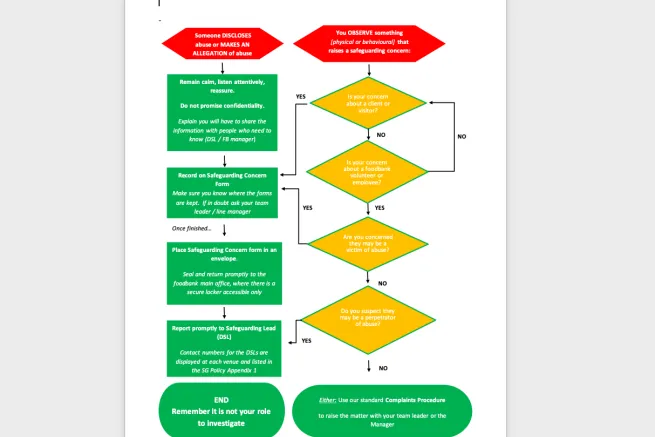
Read this section in conjunction with our safeguarding concern flowchart, to be found at Appendix 3.
All Staff or volunteers must raise their concerns with the Designated Safeguarding Lead, their deputy or if they are not available the Foodbank Manager. If the subject of concern is a member of staff or volunteer see Craigavon Area Compassion Project/Craigavon Area Foodbank ProjectWhistle Blowing Policy (Appendix 4). The Whistle Blowing Policy should be used when a member staff or volunteer has concerns about the conduct of a colleague in a position of trust within the organisation, which could be detrimental to the safety or wellbeing of adults and children.
Things to Remember
- All allegations/disclosures will be treated seriously - the safety of the vulnerable adult or child is paramount.
- Staff and volunteers should stay calm, listen and reassure the person they are concerned about that they are being listened to.
- Staff and volunteers should always demonstrate a sensitive approach.
- Staff and volunteers should be aware of the possibility of a police investigation, and are not to investigate any allegation themselves.
- Staff and volunteers will explain that they are required to share information with those people who need to know but not with other staff or volunteers. Absolute confidentiality cannot be promised.
- If there is immediate danger, or someone requires urgent medical attention, then the police or ambulance should be called immediately (on 999 or 112), and the Designated Safeguarding Lead informed as soon as possible.
10.1 Reporting Procedure
- Any concerns should be reported immediately to the Designated Safeguarding Lead, their deputy or in their absence the Foodbank Manager who will decide whether to contact the Thirtyone:eight helpline who can advise on appropriate next steps including whether to refer to statutory services.
- A Safeguarding Concern Report Form (Appendix 2) will be completed by the employee/volunteer or by the Designated Safeguarding Lead using information relayed by the person reporting the concern. Information recorded on the form must:
- Be accurate and factual – do not make subjective judgements or supposition.
- Wherever possible include the actual words said by the child or vulnerable adult rather than an interpretation of what was said.
- Record only specific facts relating to disclosure, dates, places etc. should be recorded accurately along with any details of the injuries or consequences i.e. where they are and what they looked like.
- Consider if the incident also needs to reported under Health and Safety Policy and Procedures.
- Where necessary the Designated Safeguarding Lead will report the concern to Statutory Children’s/Adults Social Care Services, providing a copy of the Safeguarding Concern Form, and where appropriate a chronology of events.
- If a criminal offence has been committed, the Foodbank Manager or the Designated Safeguarding Lead will call the police and any other linked agencies as necessary.
- Children’s or Adult’s Social Care may then take the lead on any investigation and inform other agencies, where appropriate.
- The Designated Safeguarding Lead will provide any further information to statutory Services as required.
- Completed Safeguarding Concern Forms will be kept centrally by the Safeguarding Lead, stored in a locked cabinet at Unit 14 Office with restricted access, away from other personal files. Where completed Safeguarding Concern forms are stored electronically, they will be kept in a password protected folder on SharePoint with restricted access in line with this policy and the Data Protection Policy.
- Where incidents that have resulted in (or risk) significant harm to beneficiaries, the Designated Safeguarding Lead will notify the Board of Trustees who may be required to be report the incident to the charities regulator as a Serious Incident Report (cf. Section 11 - Monitoring).
10.2 Domestic violence
- Where a person visiting the foodbank reports an incident of domestic violence whilst a child or vulnerable adult is in the home, this must be treated as a disclosure of abuse and should be passed on to a Designated Safeguarding Lead with immediate effect using the procedures outlined above.
- Where an incident of domestic violence is reported and there is no child or vulnerable adult present, foodbank staff and volunteers should as a minimum signpost the client to an appropriate agency but must not attempt to coerce them to contact the police unless the client wants and feels able to do so.
- Where foodbank staff or volunteers witness an act of domestic violence, they must contact the police immediately.
- For advice or information about anything relating to domestic violence the foodbank team should contact the National Domestic Violence Helpline: 0808 2000 247
- MONITORING
Information about safeguarding cases and how they were dealt will be reviewed and reported on regularly to the Board of Trustees. Areas to focus on include:
- How quickly the concern was reported to the Safeguarding Lead
- Whether a concern was reported to statutory agencies
- How quickly a concern was made to the police/Children’s/Adults Services (where relevant)
- Accuracy of information recorded
- The quality of the input into the safeguarding process (feedback from Police/Children’s/Adults Services)
- Outcomes of safeguarding process
- Whether any incidents highlighted training issues or a need to amend in-house procedures
- Whether the incident should be notified to the charity regulator under Serious Incident Reporting procedures
Reports to trustees should focus on the issues and the organisation’s response to an incident not the specific details of an individual case. Reports made to the trustees should be captured in a Safeguarding Incident Register. This is to enable the organisation to reflect on and improve its practice in developing an effective safeguarding culture.
The policy and procedure will be reviewed and audited regularly or if legislation changes.
- GOOD PRACTICE
12.1 Safer Recruitment of staff and volunteers
- References will be taken up according to the guidelines below:
- Employees: Two references after acceptance of a provisional job offer which is subject to receipt of satisfactory references.
- Volunteers applying for or appointed to leadership positions, and Signposters: Two references at the time of application/appointment to be received before they start the role;
- All other posts: Two references to be obtained after successful completion of a four-session trial-period - during the trial period they will be subject to continuous supervision.
- Employees: Two references after acceptance of a provisional job offer which is subject to receipt of satisfactory references.
- In all cases at least one of the references should be from a recent past employer or from another organisation the person has volunteered with, if they have no recent employment history.
- References should be provided in writing or transcribed where received verbally. Craigavon Area Compassion Project/Craigavon Area Foodbank make all reasonable efforts to ensure that references are bona-fide and will seek alternatives where in doubt.
- All staff and volunteers have a duty to disclose any unspent convictions. Failing to do so may be regarded as gross misconduct or a breach of the volunteering agreement.
- All staff and volunteers responsible for supervising vulnerable adults or children will undergo an enhanced criminal records check if their role falls within the eligibility guidelines (cf. Appendix 1 for links to guidance on eligibility).
- Staff and volunteers without a criminal records check will not be permitted unsupervised access to vulnerable adults or children.
All criminal records check will be renewed every three years.
12.2 Training
- All staff and volunteers will familiarise themselves with all Craigavon Area Compassion Project/Craigavon Area Foodbank policies and procedures, including safeguarding, during induction.
- All staff and volunteers will complete basic Safeguarding training every two years and other relevant training as required.
All trustees, volunteers and staff will be made aware of:
- The possibilities of abuse and neglect of children and vulnerable adults
- Local procedures and know the names and contact details of relevant local and national professionals and organisations (see Appendix 1).
All staff and volunteers, including trustees, will be required to undertake refresher safeguarding training at least biennially (every two years).
12.3 Supported Volunteers
- All volunteers will be asked whether they have any specific or additional support needs, or other relevant information like unspent criminal convictions that indicates a need for additional support Craigavon Area Compassion Project/Craigavon Area Foodbank.
- Where significant additional support needs are disclosed or identified the volunteer will be regarded as a supported volunteer.
- Where Craigavon Area Compassion Project/Craigavon Area Foodbank offers supported volunteering opportunities, including for young people or volunteers with additional needs, then the supervisor will be subject to an enhanced criminal records check.
- Supported volunteering placements will be subject to individual assessment to ensure appropriate management and support for specific additional support needs identified.
- All Supported volunteers will receive an individual support assessment which will be regularly reviewed with the volunteer coordinator or their supervisor.
- Craigavon Area Compassion Project/Craigavon Area Foodbank will ensure that all volunteers, including young people or volunteers with additional needs receive appropriate support to understand this safeguarding policy and know who to talk to if they feel unsafe.
- If the volunteer is likely to struggle to absorb the information contained within this policy by reading it, the volunteer coordinator, supervisor or a Designated Safeguarding Lead will talk through the policy verbally.
- Craigavon Area Compassion Project/Craigavon Area Foodbank will produced a easy-read safeguarding reporting procedure, which can be printed out and given to staff and volunteers.
- Safeguarding is discussed at regular team meetings and supervisors are encouraged to raise issues about their area of work and discuss them.
- When facilitating supported volunteering, supervisors will observe for any situation or suggestion that a vulnerable adult or child is being either highly favoured or harshly treated, as these may be signs of abuse.
- Our priority is protecting the welfare of all supported volunteers whether vulnerable-adults or children. Where possible, line managers should take opportunities to observe those vulnerable adults and children for whom they are responsible.
13. MANAGEMENT AND SUPERVISION
Unless expressly delegated to Managers or the Designated Safeguarding Lead, trustees are responsible for clarifying with staff and volunteers their roles and responsibilities regarding the safeguarding of children and vulnerable adults. Supervision of staff and volunteers will monitor working practices and offer the opportunity to raise any concerns.
- ROLES AND RESPONSIBILITIES
| NAME | ROLE/RESPONSIBILITIES | CONTACT DETAILS |
| Emma Beggs | Designated Safeguarding Lead |
07703800138 emma@craigavonfoodbank.org.uk |
| Diane Guiney | Deputy Designated Safeguarding Lead |
07787506473 diane@craigavonfoodbank.org.uk
|
| Maurice McDonagh | Safeguarding Trustee | 07732906587 Maurice.mcdonagh@gmail.com |
| Chris Leech | Chair of Trustees | 07866605027 chris@craigavonfoodbank.org.uk |
- The Designated Safeguarding Leads will never be related to each other.
- The Designated Safeguarding Leads will both hold a personal copy of this Policy.
***********************************************************************************
For completion each time the policy is reviewed / edited:
| Safeguarding Trustee | Maurice McDonagh |
| Monitoring of the procedures | Safeguarding Trustee |
| Reporting To | Trustee Board |
| Next Review Date | 01/06/27 |
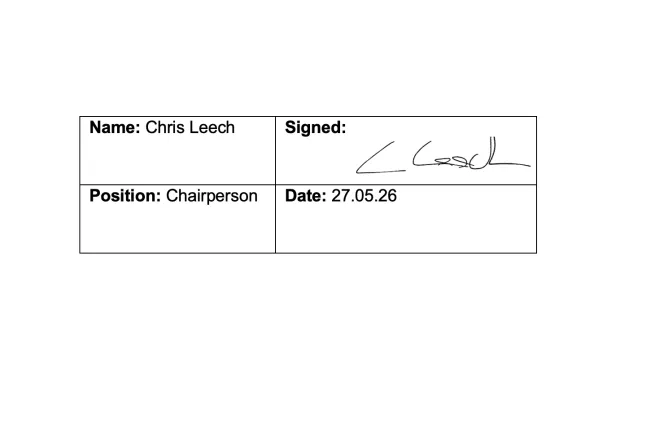
This policy was approved by the Trustees:
- Appendix 1 - Key Contacts & Foodbank Venues
If someone is injured or in imminent danger, call: 112/999
Our Key Contacts
- Designated Safeguarding Lead 07702630141
- Deputy Designated Safeguarding Lead 07787506473
- Thirtyone:eight Advice line 0303 003 11 11 (option 2)
Social Services
| Local Authority is Southern Trust | |
| Social Services – Office Hours |
9.00am-5.00pm
|
Social Care Services Daytime Contact Numbers | Adult Access Point: 028 9050 7000 Children’s Access Point: 028 3756 7100 |
Gateway Team Out-of-Hours Emergency Duty Team (EDT) | Adults AND Children: 0800 783 7745 |
Other National Advice Providers
- The Action Elder Abuse Confidential Free phone help Line - 0808 808 8141 - 9am-5pm
- ChildLine - 0800 1111
- NSPCC 24/7 Child Protection Helpline - 0808 800 500 or help@nspcc.org
- National Domestic Violence Helpline – 0808 2000 247
- Samaritans – 116 123
If you think a crime has taken place…
- Local & Regional Police – Non-emergency number: 101
- You will be directed to the correct team for your postcode area.
Operational Premises/Venues: Craigavon Area Foodbank operates from the following venues:
Foodbank Activity And operating times | Venue & Address | Landlord Contact Details for Host Venues and Safeguarding Lead (if known) for Host organisation
|
Main Office Mon – Fri: 9 – 3 | Unit 14 Carn Business Park Craigavon, BT63 5WG | Noel Eakin 028 3833 9870 |
Warehouse Mon 9-12, Thur 9-12 | Unit 5 Carn Business Park Craigavon, BT63 5WG | Noel Eakin 028 3833 9870 |
Portadown Distribution Centre Fri 11-12 | Emmanuel Church Portadown 32 Meadow Lane BT62 3NH | Emmanuel Church Portadown 07866 605027
|
Lurgan Distribution Centre Tues & Thurs 11-12 | The Salvation Army Union St BT66 8ED | The Salvation Army 028 3832 3222 |
Craigavon Distribution Centre Tues 11-12 | Craigavon Presbyterian Church 25 Drumgor Road BT65 6BP | Craigavon Presbyterian Church 028 3898 5862 |
Statutory Care regulator
The Regulation and Quality Improvement Authority
Helpline Tel: 028 9536 1990
Criminal Records Check
Access NI
PO Box 1085 Belfast BT5 9LE
0300 200 7888
https://www.nidirect.gov.uk/campaigns/accessni-criminal-record-checks
APPENDIX 2 - SAFEGUARDING INCIDENT REPORTING FORM
(Confidential when complete)
| For Office Use | |||
| Date and Time of Incident | |||
| Name of Person Completing this form | |||
| Passed to Designated Safeguarding Lead (SO) | |||
| Method of communication | |||
| Received by Designated Safeguarding Lead | |||
| About the Incident, Safeguarding Concern or Identified Risks | |||
| |||
About the person(s) at risk Full Name: Address:
Date of birth: Gender: | |||
Is the alleged perpetrator known to the person at risk: ☐Yes ☐No | |||
What is their relationship to the person at risk:
| |||
Please provide a brief description of the allegation/concerns: Use this space to clarify basic information. Record factual details about what was said. Include:
| |||
Please provide a brief outline of actions taken/ support offered: Outline what action was taken at the time of the incident. If there is evidence what has been done to preserve this etc.
| |||
Have you discussed your concerns with the person at risk (or legal guardian in the case of a child), where doing so does not increase the risk of harm and informed them of any actions you proposed to take: ☐Yes ☐No Has the person at risk given their consent to sharing the information with appropriate external agencies and/or statutory services: ☐Yes ☐No | |||
| Once completed, use as a prompt when reporting your concern and then place in an envelope, seal and ensure prompt delivery to the Designated Safeguarding Officer. | |||
| For the Designated Safeguarding Lead to complete | |||
| Type of risk/ abuse identified or suspected (select all that apply): | |||
| |||
Additional actions/ measures:
| |||
Is a further Risk Assessment needed for the FB to managed identified risks/ concerns: ☐Yes ☐No | |||
Has the incident/ concern been reported to statutory social care services: ☐Yes ☐No | |||
Concerns shared with external agencies: N.B. If you have concerns for a person’s immediate safety then contact the emergency services. | ☐Police ☐Social Care ☐Original referral agency ☐31:8 ☐Trussell Trust Area Manager ☐Other (If other please specify):
| ||
Safeguarding Incident Register updated for the charity Trustees/ Management Group: ☐Yes ☐No | |||
Appendix 3 – SafeGuarding Concern Flowchart
Appendix 4 - Signs and Symptoms of Abuse (Children)
The following signs could be indicators that abuse has taken place but should be considered in context of the child’s whole life.
Physical
- Injuries not consistent with the explanation given for them
- Injuries that occur in places not normally exposed to falls, rough games, etc
- Injuries that have not received medical attention
- Reluctance to change for, or participate in, games or swimming
- Repeated urinary infections or unexplained tummy pains
- Bruises on babies, bites, burns, fractures etc which do not have an accidental explanation*
- Cuts/scratches/substance abuse*
- Any allegations made concerning sexual abuse
- Excessive preoccupation with sexual matters and detailed knowledge of adult sexual behaviour
- Age-inappropriate sexual activity through words, play or drawing
- Inappropriate bed-sharing arrangements at home
- Severe sleep disturbances with fears, phobias, vivid dreams or nightmares, sometimes with overt or veiled sexual connotations
- Eating disorders - anorexia, bulimia*
- Changes or regression in mood or behaviour, particularly where a child withdraws or becomes clinging.
- Depression, aggression, extreme anxiety.
- Nervousness, frozen watchfulness
- Obsessions or phobias
- Sudden under-achievement or lack of concentration
- Inappropriate relationships with peers and/or adults
- Attention-seeking behaviour
- Persistent tiredness
- Running away/stealing/lying
Sexual
Child who is sexually provocative or seductive with adults
Emotional
Neglect
- Under nourishment, failure to grow, constant hunger, stealing or gorging food, Untreated illnesses, inadequate care, etc
*These indicate the possibility that a child or young person is self-harming. Approximately 20,000 are treated in accident and emergency departments in the UK each year.
APPENDIX 5 - SIGNS AND SYMPTOMS OF ABUSE (ADULTS)
The following signs could be indicators that abuse has taken place but should be considered in context of the person’s whole life.
Physical abuse
- History of unexplained falls, fractures, bruises, burns, minor injuries
- Signs of under or overuse of medication and/or medical problems left unattended
- Any injuries not consistent with the explanation given for them
- Bruising and discolouration - particularly if there is a lot of bruising of different ages
and in places not normally exposed to falls, rough games etc
- Recurring injuries without plausible explanation
- Loss of hair, loss of weight and change of appetite
- Person flinches at physical contact &/or keeps fully covered, even in hot weather
- Person appears frightened or subdued in the presence of a particular person or people
Domestic violence
- Unexplained injuries or ‘excuses’ for marks or scars
- Coercive, controlling and/or threatening relationship including psychological, physical, sexual, financial, emotional abuse; so-called ‘honour’ based violence and Female Genital Mutilation
Sexual abuse
- Pregnancy in a woman who lacks mental capacity or is unable to consent to sexual intercourse
- Unexplained change in behaviour or sexually explicit behaviour
- Torn, stained or bloody underwear and/or unusual difficulty in walking or sitting
- Infections or sexually transmitted diseases
- Full or partial disclosures or hints of sexual abuse (that may be accompanied by some of the following additional symptoms):
Self-harming
Emotional distress
Mood changes
Disturbed sleep patterns
Psychological abuse
Alteration in psychological state e.g. withdrawn, agitated, anxious, tearful
Intimidated or subdued in the presence of a particular person
Fearful, flinching or frightened of making choices or expressing wishes
Unexplained paranoia
Changes in mood, attitude and behaviour, excessive fear or anxiety
Changes in sleep pattern or persistent tiredness
Loss of appetite
Helplessness or passivity
Confusion or disorientation
Implausible stories and attention seeking behaviour
Low self-esteem
Financial or material abuse
- Disparity between assets and living conditions
- Unexplained withdrawals from accounts or disappearance of financial documents or loss of money
- Sudden inability to pay bills, getting into debt
- Carers or professionals fail to account for expenses incurred on a person’s behalf
- Recent changes of deeds or title to property
- Missing personal belongings
- Inappropriate granting and / or use of Power of Attorney
Modern slavery
- Physical appearance; unkempt, inappropriate clothing, malnourished
- Movement monitored, rarely alone, travel early or late at night to facilitate working hours.
- Few personal possessions or ID documents.
- Fear of seeking help or trusting people.
Discriminatory abuse
- Inappropriate remarks, comments or lack of respect
- Poor quality or avoidance care
- Low self-esteem
- Withdrawn
- Anger
- Person puts themselves down in terms of their gender identity or sexuality
Institutional Abuse
- Low self-esteem
- Withdrawn
- Anger
- Person puts themselves down in terms of their gender identity or sexuality
- No confidence in complaints procedures for staff or service users.
- Neglectful or poor professional practice.
Neglect and acts of omission
- Deteriorating despite apparent care
- Poor home conditions, clothing or care and support.
- Lack of medication or medical intervention
Self-neglect
- Hoarding inside or outside a property
- Neglecting personal hygiene or medical needs
- Person looking unkempt or dirty and has poor personal hygiene
- Person is malnourished, has sudden or continuous weight loss and is dehydrated – constant hunger, stealing or gorging on food
- Person is dressed inappropriately for the weather conditions
- Dirt, urine or faecal smells in a person’s environment
- Home environment does not meet basic needs (for example not heating or lighting)
- Depression
Appendix 6 - Whistle Blowing
Safeguarding & whistle blowing
This appendix covers concerns that staff have about the conduct of individuals in a position of trust within the organisation, which could be detrimental to the safety or wellbeing of adults and children and where staff, for whatever reason, feel unable to raise them under the organisation’s standard complaints procedures. This procedure is also available to the organisation’s volunteers (including foodbank volunteers) should they feel unable to raise a safeguarding concern using the channels outlined in this policy. It relates to raising concerns about:
- Unprofessional behaviour
- Bullying by staff
- Any form of abuse (physical, sexual, emotional or neglect)
- Name calling
- Personal contact with adults, children and young people which is contrary to the organisation’s policies and codes of conduct
- Any form of racial abuse
- Inappropriate sexualised behaviour
- Knowledge about an individual’s personal circumstances which may indicate they could be a risk to adults and/or children
- Persistent and enduring rumours including un-investigated historical rumours.
Where a person raising concerns is unable to raise the matter with either the Designated Safeguarding Lead, their deputy or the Foodbank Manager, then they can contact the Chair of Trustees who is responsible for the oversight of the Governance of the Charity. If the person raising the concern feels the Chair of Trustees has not appropriate addressed the concerns raised, then they can seek further recourse via the following means:
If it is felt there exists a significant risk of harm being caused to another person, then the person can raise their concerns directly with social services or,
As a member of the Trussell Trust Foodbank Network a person can also make a complaint about the foodbank’s handling of the concern via the Trussell Trust’s complaints procedure, details of which can be accessed from the Trussell Trust website https://www.trusselltrust.org/trussell-trust-complaints-policy-and-procedure-july-2020/
Appendix 7 (IV) - Key Legislation in Northern Ireland
Legal Framework Children and Young People:
- The Children (Northern Ireland) Order 1995
- Safeguarding Vulnerable Groups (Northern Ireland) Order 2007
- Protection of Freedoms Act 2012
- Safeguarding Board Act (Northern Ireland) 2011
- Children’s Services Co-operation Act (Northern Ireland) 2015
- Section 5 of the Criminal Law Act (Northern Ireland) 1967
- Co-operating to Safeguard Children and young people in Northern Ireland (Department of Health, 2017)
- Education and Libraries (Northern Ireland) Order 2003
- Revised regional core child protection policies and procedures for Northern Ireland (Safeguarding Board for Northern Ireland, 2018)
Legal Framework Vulnerable Adults:
- Health and Personal Social Services (Quality, Improvement and Regulation) (NI) Order 2003
- Adult Safeguarding: Prevention and Protection in Partnership 2015
- The Mental Capacity Act (Northern Ireland) 2016
- Carers and Direct Payments Act (NI) 2002
- Carers’ Strategy NI (2006)
- Human Rights Act of 1998
- Safeguarding Vulnerable Groups (Northern Ireland) Order 2007
- Protection of Freedoms Act 2012
- The following 6 general principles underpin all adult safeguarding work:
- Empowerment – People being supported and encouraged to make their own decisions with informed consent
- Prevention – It is better to take action before harm occurs
- Proportion – The least intrusive response appropriate to the risk presented
- Protection – Support and representation for those in greatest need
- Partnership – Local solutions through services working with their communities. Communities have a part to play in preventing, detecting and reporting neglect and abuse
- Accountability – Accountability and transparency in delivering safeguarding
APPENDIX 8 – INCIDENT REPORT LOGS AND INCIDENT REPORTING TO TRUSTEES
The role of the DSLs (the Designated Safeguarding Lead and their Deputy) is to collate and clarify the precise details of the allegation or suspicion and pass this information on to statutory agencies, who have a legal duty to investigate.
The Designated Safeguarding Leads are also responsible for ensuring the organisation keeps appropriate records of any concerns, disclosures and investigations as part of ensuring the policy and procedure is fit for purpose and kept under continual review. The trustees will support the Safeguarding Lead/ Deputies in their role, and accept that any information they may have in their possession will be shared in a strictly limited way on a need to know basis.
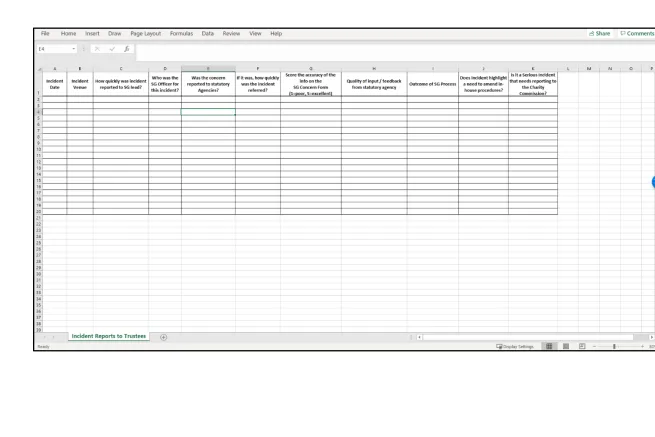
Information about safeguarding cases and how they were dealt will be reviewed and reported on regularly to the Trustees. Areas of focus will include:
- How quickly a disclosure was reported to the Designated Safeguarding Lead
- Whether a disclosure was referred to statutory agencies
- Where relevant, following a disclosure, how quickly the referral was made to statutory services.
- The quality of the input into the safeguarding process (feedback from police/ Adults Services)
- Outcomes of the safeguarding process
- Whether incidents highlight any concerning trend or pattens, any training needs or failure in procedures that require review
- Whether the incident should be notified to the charity regulator under Serious Incident Reporting procedures
Reports to the Trustees focus on the issues and the organisation’s response to an incident, not the specific details of an individual case. Safeguarding incidents and investigations and will captured in a Safeguarding Incident Register maintained by the Designated Safeguarding Lead. This is to enable the organisation to reflect on and improve its practice in developing an effective safeguarding culture.
Reporting to Trustees