
 Get emergency food
Health and Safety Policy
Health and Safety Policy and Operational Procedures May 2026
For Craigavon Area Compassion Project
(Craigavon Area Foodbank)
Charity Number: NIC103987
Unit 5, Carn Business Park, Craigavon BT63 5WG
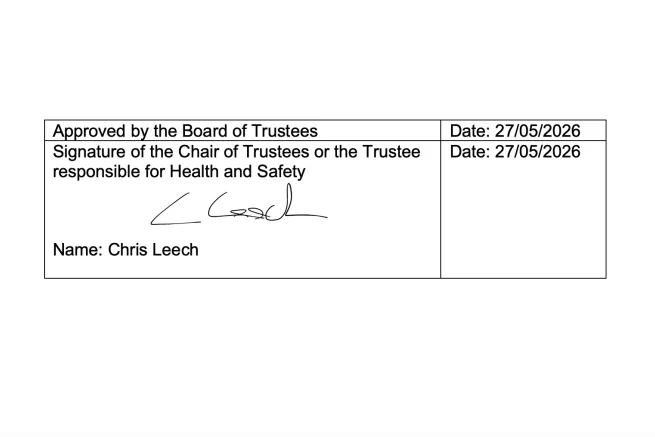
Revision Record (Policy, Risk Assessments and Procedures to be reviewed at least annually even if there are no changes)
| Revision | Date | Section Revised | Brief Description of Revisions Made |
| 1 | 27.05.26 | All | Trussell template adapted. Statement of intent signed. Responsibilities assigned. Arrangements for Health & Safety |
Contents
| Description | Section Ref |
| Health and Safety Policy | |
| Statement of Intent | Part 1 |
| Responsibilities for Health and Safety | Part 2 |
| Arrangements for Health and Safety | Part 3 |
| Appendix A - Operational Procedures | |
| Emergency First Aid | P1 |
| Clothing and Personal Protective Equipment (PPE) | P2 |
| Working Environment (including buildings) | P3 |
| Display Screen Equipment (DSE) | P4 |
| Access for People with Disabilities | P5 |
| Lone Working | P6 |
| Violent and Aggressive Behaviour | P7 |
| Working with Children, Young People Under 18 and Adults with Care and Support Needs | P8 |
| New and Expectant Mothers | P9 |
| Waste Disposal | P10 |
| Smoking (including vaping) | P11 |
| Alcohol or Substance Abuse | P12 |
| Work-related Stress | P13 |
| Violence, Harassment and Bullying | P14 |
| Equipment | P15 |
| Manual Handling and Lifting | P16 |
| Working at Height | P17 |
| Use of Vehicles | P18 |
| Pedestrian Vehicle Separation | P19 |
| Electrical Safety | P20 |
| Electricity Related Injury | P21 |
| Care of Substances Hazardous to Health (COSHH) | P22 |
| Emergency Food | P23 |
| Rodent and Pest Control | P24 |
| Management and Handling of Cash | P25 |
| Fire Precautions and Procedures | P26 |
| Bomb Alert or Other Terrorist Alert | P27 |
Health and Safety Policy
Reference hyperlink: HSE Simple Health and Safety Policy
Part 1: Statement of Intent
Craigavon Area Compassion Project/Craigavon Area Foodbank recognise that good health and safety management supports the delivery of services and projects in all locations where it operates. Craigavon Area Compassion Project/Craigavon Area Foodbank is committed to ensuring so far as reasonably practicable, the health, safety and welfare of employees, temporary workers, volunteers, contractors (collectively called Representatives) and members of the public who may be affected by our activities. Craigavon Area Compassion Project/Craigavon Area Foodbank declares its intention to satisfy the requirements of the Health and Safety at Work etc. Act 1974 and all other relevant legislation or Regulations.
Craigavon Area Compassion Project/Craigavon Area Foodbank will:
- Comply with all relevant statutory requirements for health, safety and welfare.
- Consult with Representatives at all levels in order to improve the health and safety culture across all areas of the organisation.
- Ensure that all Representatives have access to and are aware of the Health and Safety Policy, procedures and guidance.
- Undertake risk assessments that are suitable and sufficient for work activities and implement appropriate risk control measures.
- Provide and maintain a safe place of work, including safe access to and egress from, for Representatives and members of the public visiting Our premises or accessing our services.
- Implement safe systems and processes for all activities conducted.
- Provide information, instruction, training and supervision of Representatives in matters of health and safety.
- Provide Personal Protective Equipment (PPE) where required and maintain safe equipment.
- Ensure safe use, handling, storage and transport of articles and substances used or associated in the provision of Craigavon Area Compassion Project services or activities.
- Implement a procedure for the recording, reporting and investigating of accidents, incidents, near misses and instances of ill health to determine if such are the result of Craigavon Area Compassion Project/Craigavon Area Foodbank’s activities.
- Provide regular report on Craigavon Area Compassion Project/Craigavon Area Foodbank’s health and safety performance to the Trustees and ensure the report contains proposals for the continual improvement of health and safety management as appropriate.
- Review this Health and Safety Policy together with the Operational Procedures annually or earlier when there change to the operational environment.
Part 2: Responsibilities for Health and Safety
The responsibility for the management of health and safety within Craigavon Area Compassion Project/Craigavon Area Foodbank is set out in the following table:
| Responsible Person(s) | Responsibilities |
Trustees Chris Leech Chris@craigavonfoodabnk.org.uk 07866605027 | The Trustees have personal responsibility for the health, safety and welfare of all those acting under their direction or control including visitors at all sites where the charity operates. The Trustees are also responsible for directing the preparation and review of health and safety policy.
|
Fire Warden(s)
Paul Swaffield 07778559352
Jim Freeburn jim@craigavonfoodbank.org.uk 07767401213
Emma Beggs 07702630141 | The person(s) responsible for fire safety in the premises being used by the food bank. Their responsibilities (as defined by HSE) are as follows:
|
Health and Safety Advisor
Diane Guiney diane@craigavonfoodbank.org.uk 07787506473
| The identification of risks and completion of risk assessments, preparation of operational procedures, development of safe working practices, the provision of health and safety information and training.
|
Project Manager
Diane Guiney diane@craigavonfoodbank.org.uk 07787506473
| Daily supervision of safe working, carrying out risk assessments and developing safe procedures, and the reporting of incidents.
|
First Aider(s)
Paul Swaffield 07778559352
Julie Swaffield julie@craigavonfoodbank.org.uk 07901975293 | Specific responsibilities are covered in Arrangements for Health and Safety, Risk Assessments (including mitigations) and the Operational Procedures (refer to Appendix A).
|
Representatives (including staff and volunteers)
Jim Freeburn jim@craigavonfoodbank.org.uk 07767401213
Paul Swaffield 07778559352
Emma Beggs 07702630141
Diane Guiney diane@craigavonfoodbank.org.uk 07787506473
| Representatives have a duty to take reasonable care for their own safety and that of others who may be affected by their actions or omissions. All are to be familiar with the
provisions dealing with emergencies, fire precautions, first aid, evacuation and safe working. They have a duty to comply with the food bank health and safety policy statement and operational procedures, and not to misuse or recklessly interfere with anything provided. Failure to do so may result in disciplinary action, if an employee including dismissal where appropriate or will be asked to leave the role if a volunteer. They are required to report anything they suspect may represent a safety hazard to their Line Manager. Those with disabilities or conditions, whether permanent or temporary, which they suspect may represent a potential risk should inform their Line Manager so that safe procedures can be put in place by the Project Manager in a timely manner.
|
| Trustees, Employees and Volunteers | The responsibility for visitors (including members of the public/clients/contractors) rests with the person that invited them, and they should be escorted whenever practical and reasonable. Visitors should be given such fire, evacuation and safety information, instruction or training as may be necessary or appropriate. Visitors also have a duty to comply with the food bank health and safety policy and procedures, and not to misuse or recklessly interfere with anything provided. There should be a record of visitors to the food bank building or premises so they can be accounted for in case of fire, which can be found at the weighing-in area. |
Part 3: Arrangements for Health and Safety
Risk Assessment
Craigavon Area Compassion Project/Craigavon Area Foodbank has carried out risk assessments of the hazards identified in food bank premises and at food bank activities carried out elsewhere and has put in place procedures to reduce the risk to a reasonable level. Any new activity or change in procedure or
environment which is likely to present a hazard should be reported to the Project Manager or Operations Manager immediately.
The risk assessments are supported by Operational Procedures in Appendix A which are a set of are a set of standardised actions.
Training
Initial health and safety training covering fire, evacuation, and other key safety procedures including first aid for all Representatives is to be carried out during induction by the Warehouse Manager, Operations Manager or Project Manager and signed off.
Work process and related equipment training is to be carried out by the Warehouse Manager, or approved volunteer and recorded where appropriate.
Induction and training records are to be kept centrally by the Project Manager and/or Operations Manager. This training will be marked down and recorded so refresher sessions can be offered at the appropriate time.
All staff and volunteers are to receive instruction before using any equipment provided by the food bank, using Manufacturer’s instructions where appropriate.
If, subsequently, they are in any doubt about their familiarity with the equipment or its safe use they have a duty not to use the equipment until they are satisfied they can use it safely.
Information
Health and safety information is readily available from a wide range of sources, particularly the Health and Safety Executive website and from local health authorities. General health and safety materials are available from the Project Manager and Operations Manager, and posters or leaflets specific to issues that are considered a risk by the food bank are prominently displayed in work areas and used in health and safety instruction or training.
The charity Health and Safety Document Register is stored in the following location: Unit 5 & 14 Carn Business Park, 19 Carn Road, Portadown (BT63 5WG).
Consultation
The Project Manager and Operations Manager will consult with the Representatives on Health and Safety matters. Representatives are encouraged to constantly challenge health and safety policies, risk assessments and operational procedures to build a health and safety culture and ensure continual improvement in the prevention of ill health and injury in the course of their duties.
Reporting of Accidents, Near Misses or Serious Incidents
All accidents or near misses are to be reported to the Line Manager for investigation.The Project Manager when required by law, will report accidents or ill health at work. (Reporting of Injuries, Diseases and Dangerous Occurrences Regulations 2013) https://www.hse.gov.uk/riddor/
In general, every incident which results in, or could have resulted in the death, serious injury or injury over 7-days (including that caused by violence) must be reported to the HSE within 10 days or 15 days if a 7-day reportable injury. Injury to members of the public must be reported if they travel from the scene of the incident to hospital and receive treatment.
All accidents, incidents and near misses should be entered in the accident book.
Evacuation
Refer to the Operational Procedures in Appendix A.
Appendix A - Operational Procedures
These safety procedures have been compiled following risk assessments of likely hazards arising from the building, environment and activities carried out by the food bank. When new processes, activities or changes occur, additional assessments should be made, and these procedures amended in a timely manner.
P1 Emergency First Aid It is the responsibility of the Project Manager to maintain adequately stocked first aid boxes. These are located in both warehouses at the kitchen area and in the office on the file cabinet. All personnel are to familiarise themselves as to their location and the list of First Aid qualified personnel. The Project Manager will arrange for a first aid risk assessment to be carried out and based on this assessment, training for a number of personnel to provide adequate cover for the building. A published list of qualified personnel and their location will be placed at reception. In the event of an incident requiring first aid the person first on the scene should:
The first person providing first aid should:
The Line Manager present should record the incident in the accident book. Report the accident in accordance with RIDDOR and make a report to the Trustees and Project Manager. |
P2 Clothing and Personal Protective Equipment (PPE) The food bank will provide Representatives with all clothing and Personal Protective Equipment (PPE) necessary for them to carry out their role. Representatives are to use the clothing and PPE provided and report any deficiencies promptly to the Warehouse Manager. No personal PPE can be brought into the food bank without the approval of the Warehouse Manager and mandatory safety checks being carried out. Provision and use of equipment (other than PPE) provided by the food bank is covered by Procedure. Reference hyperlinks: HSE Personal protective equipment (PPE) at work regulations from 06-Apr-22 and HSE Personal Protective Equipment (PPE) at Work |
P3 Working Environment (including buildings) General The food bank will ensure that workplaces are:
Reference hyperlink: HSE Workplace health, safety and welfare, A short guide for managers Fire Safety The food bank has carried out a full check of the buildings occupied and ensured that they are compliant with current fire safety requirements (Fire Precautions Workplace Regulations). Fire safety and evacuation procedures must be rigorously implemented with particular attention to the prevention of fire and the provision of safe evacuation routes which must be kept clear at all times. The food bank has carried out a fire safety risk assessment and undertakes to keep it up to date. Reference hyperlinks: GOV.UK Fire safety in the workplace and HSE Introduction to fire safety. Our Fire Safety Risk Assessment can be found here. Evacuation plans will take into account those that are handicapped or have limited mobility and may take longer to get out of the building. Slips and Trips The food bank is aware that most trips are caused by obstructions in walkways. The rest are caused by uneven surfaces. The food bank therefore undertakes to keep walkways clear and maintain surfaces trafficked by pedestrians to mitigate the risk. Reference hyperlink: HSE Slips and trips Statutory Checks The food bank undertakes to work with the landlord to ensure that appropriate statutory checks have and continue to be undertaken regarding such items listed below in all buildings occupied.
Corridors and working spaces must be kept clear of rubbish, equipment, cables or any other item that might constrain evacuation routes or present a tripping or other hazard. Construction Work Where construction work of any type is to be undertaken on the property then the food bank should refer to the Construction (Design and Management) Regulations as to what their duties are regarding the construction, cleaning and maintaining the building or work with owner/landlord to ensure duties are followed: HSE Summary of duties under Construction (Design and Management) Regulations 2015 (CDM 2015) and HSE Commercial clients: roles and responsibilities |
P4 Display Screen Equipment (DSE) The food bank will protect those Representatives who use Display Screen Equipment (DSE) daily, for continuous periods of an hour or more in accordance with The Health and Safety (Display Screen Equipment) Regulations. In order to do this, the food bank will follow the Health and Safety Executive (HSE) Guidance for Employers Working safely with display screen equipment including:
This procedure applies to mobile Representatives and those working at a fixed workstation, at home, or hot-desking. |
P5 Access for People with Disabilities The food bank, in conjunction with the building owners should provide access to (and evacuation from) the building for those with disabilities. Disabled toilets for wheelchair users and others with restricted capabilities should be provided where appropriate, reasonable and if possible, within the building premises. Representatives with specific disabilities requiring special support will be individually assessed and appropriate reasonable provision made. |
P6 Lone Working Representatives should not be left working alone. Where this is unavoidable the following procedures should be employed:
| |||
P7 Violent and Aggressive Behaviour Health and Safety Executive (HSE) Guidance defines work-related violence as ‘Any incident in which a person is abused, threatened or assaulted in circumstances relating to their work.’ The food bank follows the HSE Guidance for Employers Violence and aggression at work - Overview - HSE including:
Where necessary Representatives are trained how to deal with aggressive and abusive behaviour. | |||
P8 Working with Children, Young People Under 18 and Adults with Care and Support Needs You can find our Safeguarding Policy here. Every effort should be made that vulnerable people are not placed at risk or pose a risk to others. Supported Representatives must never be left to work alone, but properly supervised at all times. Wherever possible, vulnerable staff are not to be left alone with one other person for protracted periods of time. Representatives are only permitted to bring their children to work in exceptional circumstances. In this case they are required to supervise them personally at all times and ensure that their behaviour does not put themselves or others at risk. Children and young people may only volunteer for specific activities in support of the food bank appropriate to their age and experience whilst supervised by an appropriate adult or food bank staff (with the agreement of parents or guardians). A record is to be kept of their attendance and activity, who is supervising them, and whether appropriate training was carried out. A child should never be left alone with an adult without the specific agreement of the appropriate adult. The types of acceptable volunteering are:
| |||
P9 New and Expectant Mothers The food bank is to comply with current regulations in respect of new or expectant mothers, providing maternity leave, conditions of work, and work procedures that are both reasonable and practical for the health and safety of mother and child. In particular:
| |||
P10 Waste Disposal All waste is to be disposed of in appropriate containers (cardboard, paper, cloth, food and rubbish). Cardboard, paper, and general rubbish is to be bagged and disposed of weekly through the council services. Food waste must be disposed of into containers that can be sealed shut, are made of appropriately robust material, are kept in good condition, and are easy to clean and disinfect. Final disposal of food waste must be in accordance with local authority rules. | |||
P11 Smoking (including vaping) The food bank operates a No-Smoking policy throughout the premises. Proper receptacles for the disposal of cigarettes are to be placed outside the outside doors and regularly emptied. | |||
P12 Alcohol or Substance Abuse Alcohol, drugs and certain other substances (including medication) may have a detrimental effect on an individual’s health and safety at work and may place other employees at risk. Representatives must NOT consume such substances whilst at work or beforehand if the effects may have a detrimental effect on them at work. If you have been prescribed medication which has a detrimental effect on you, you must discuss this with your line manager so a decision can be made whether you may attend work, and what work you can safely carry out. Employees who know they have an alcohol, drug or related problem should voluntarily seek help, diagnosis and treatment. They may discuss their problem in confidence with their line manager who can advise on where to get help. National organisations which can help are:
| |||
P13 Work-related Stress Although some stress at work may be unavoidable, the food bank will take all reasonable measures to prevent all work or task related psychiatric illness or stress. Representatives are encouraged to be open about issues relating to stress so that the food bank can take steps to reduce the risk of stress related illness, by, for example, adjusting certain conditions or workload or task load, and ensuring that all staff and volunteers receive support in the where necessary. The Health and Safety Executive (HSE) webpage Stress and mental health at work should be consulted for further information. | |||
P14 Violence, Harassment and Bullying All reasonable security precautions have been and will continue to be taken to prevent the risk of violence against food bank Representatives. The food bank welcomes suggestions to improve security and protection and will implement these where reasonable and practicable. The food bank does not accept violence, bullying or harassment of its representatives under any circumstance. Disciplinary action, for employees, will be taken against any representatives responsible for such acts. Volunteers will be asked to leave the food bank. Anyone subjected to this is encouraged to report it to the Project Manager or Operations Manager at the earliest opportunity. All complaints will be taken seriously, and the food bank will investigate these matters fully, promptly and objectively in accordance with the food bank Complaints Policy. You can find our Complaints Policy here. Disciplinary action for employees, including immediate dismissal, shall be taken against offending representatives if merited and volunteers will be removed from their role. As far as is reasonably practical, the nature of complaint and identities of those involved will be kept confidential. The Health and Safety Executive (HSE) webpage Violence and aggression at work should be consulted for further information. | |||
P15 Equipment The food bank will provide all equipment necessary for staff and volunteers to carry out the tasks given to them. No private equipment may be brought in and used without the express permission of the Project Manager, who will then ensure the equipment is safe to use and people are trained properly in its use. All equipment held by the food bank (including shelving and mobile step ladders) will be registered or logged, maintained in a safe condition and in good repair. Where applicable, equipment is to be regularly checked for safety in accordance with current regulations, and records kept. Staff and volunteers are not to use equipment they have not been trained to use. Equipment is to be used only for its due purpose and used correctly. Careless or incorrect use can result in personal injury and/or damage to the equipment. Representatives are required to report any defects in the equipment, safety device or protective equipment they are issued with to their Warehouse Manager and not to use any defective equipment. They will also put notices on faulty equipment to state that it should not be used, or the notice removed. Once the defects have been reported, the Warehouse Manager will enact the changes to repair or replace faulty equipment. | |||
P16 Manual Handling and Lifting The food bank follows Health and Safety Executive (HSE) Guidance Manual handling at work, A brief guide To reduce the risk associated with manual handling the food bank follows the hierarchy of measures to be followed as set out in the Manual Handling Regulations:
Representatives who are potentially involved in manual handling are provided with relevant job specific training. Manual handling posters are prominently displayed in relevant locations in food bank premises. Particular care is taken when loading or unloading vans or cars to ensure additional strain is not caused when lifting items on or off the van floor or bottom of the boot respectively. | |||
P17 Working at Height Loading or removing food from store shelving is the only activity routinely involving working at height. The following procedures apply to all staff and volunteers in the food bank:
Other occasions where a ladder is needed, the following procedures apply:
| |||
P18 Use of Vehicles The food bank vehicles are only to be driven by qualified permanent employees or temporarily authorised volunteers on details agreed by the food bank Project Manager, Operations Manager or Warehouse Manager only. Drivers must be over the age of 25, hold a full driving licence with no more than 6 penalty points, and have at least 3 years driving experience. A copy of the driving licence is to be given to the appropriate coordinator or manager as a record prior to using the vehicle. Temporary authorisation is to be recorded in the van driver’s log and signed by one of those listed at paragraph 4.14.6 below only. Driving licences should be rechecked on a 6-monthly basis or yearly at a minimum. The vehicle is to be maintained by the food bank in accordance with the Manufacturer’s Instructions, and full records kept. The Warehouse Manager is to carry out the daily/weekly driver’s checks stipulated in the handbook, ensure the vehicle is kept clean and in a roadworthy condition, and arrange for its servicing and MOT testing. Insurance is the legal responsibility of the vehicle owner. Drivers are not to drive under the influence of drugs (including prescribed medications if they have an effect on the driver’s capabilities) or alcohol, or if they have consumed alcohol within 8 hours of commencing driving. Drivers are to exercise due caution and common sense when driving, and fully comply with legal and Road Safety obligations. A daily vehicle check should be completed before the start of your journeys, but at a minimum it should be checked once a week. The Drivers Logbook must be completed fully prior to and on completion of each journey. Drivers unfamiliar with the van must first be given a period of familiarisation by the appropriate team member. Van drivers are to ensure that loads are properly secured so as to prevent damage or an accident when opening the doors. Use of Private Cars If a Representative uses their own car for foodbank purposes, they must ensure that their insurance provides business cover. Proof of adequate insurance, tax, ownership of a full driving licence and a current MOT certificate must be produced for inspection by the Project Manager, Operations Manager or Warehouse Manager upon renewal and at any time when so requested. Smoking in Vehicles Vehicles used for foodbank work are covered by smoking in the workplace legislation. During working hours, a personal vehicle used for business purposes also becomes a workplace. Representatives should:
Handheld Devices Handheld mobile phones or other mobile devices should not be used to make or receive calls or send messages whilst driving. Whilst driving, all such devices should be turned off or put into ‘flight’ mode and messages picked up later. | |||
P19 Pedestrian Vehicle Separation Vans, cars and in some instances lorries deliver food to, and collect food from food banks. Food is also collected from supermarkets and warehouses and other locations. The food bank is aware that:
In order to provide a safe workplace the food bank will follow the Health and Safety Executive (HSE) Guidance for Employers Workplace transport, Site Safety and Separating pedestrians and vehicles | |||
P20 Electrical Safety Anyone using electricity or electrical equipment must be aware of the danger of electrocution, shock, burns, fire and explosion. All precautions must be taken to reduce such risks. The food bank has devised, as is reasonable, safe systems for working with electrical equipment. Fixed wiring electrical systems are to be checked every 5 years by a local electrician. This should be organised by the food bank if the premises are owned or by the landlord. No food bank representatives are permitted to interfere with or attempt to maintain or repair fixed electrical systems. Representatives are to report any fault or defect in fixed or portable electrical equipment to their Line Manager, who should then isolate the equipment until it is repaired. Representatives must not replace fuses as the cause of failure may not have been identified. They will also put notices on faulty equipment to state that it should not be used, or the notice removed. All portable or moveable electrical equipment is to be registered and checked for electrical safety annually. Records are to be kept showing serial numbers, location and date of last check, and equipment should be labelled accordingly. Out of date equipment should not be used. Electrical overload should be avoided: in principle only one item should be connected to one plug or extension cable. Multiple extensions should not be used if the possible combined power requirement exceeds 3kw. In addition, care must be taken in using extension cables to avoid a tripping hazard, and ensure they are properly routed away from heat sources or sharp edges. Representatives can contribute to safe working by:
| |||
P21 Electricity Related Injury In the event of a person suffering an electric shock it is important to:
| |||
P22 Control of Substances Hazardous to Health (COSHH) Some substances in use at the food bank may cause injury or damage to health if spilt or used inappropriately. In a food bank circumstance, this will primarily relate to items like bleach or cleaning products that can irritate the skin and eyes or cause harm if ingested. In principle:
| |||
P23 Emergency Food Food collected by the food bank is for the provision of emergency food for people in crisis. It is vital that the food collected, stored and distributed is in a condition fit for consumption by the public. To this end:
| |||
P24 Rodent and Pest Control The following procedures are put in place to prevent rodents and other pests becoming a health hazard:
| |||
P25 Management and Handling of Cash The visibility and accessibility of cash poses a risk of possibly violent theft, so the following steps are to be taken to minimise this risk:
| |||
P26 Fire Precautions and Procedures Fire Precautions All Representatives and visitors to the building are required to familiarise themselves with the position of fire alarms, telephones, escape routes and firefighting equipment nearest to them. All visitors are to be escorted whilst in the building and be booked in and out within a reception area so that a record is available should evacuation be necessary. Fire alarms, detectors and extinguishers are to be inspected/serviced in accordance with the manufacturers recommendations and records retained. Emergency routes and exits are to be well signed, illuminated where necessary, and exit routes kept clear at all times. Representatives are to be given annual familiarisation training in the use of fire extinguishers. The fire evacuation plan will be exercised at least once every calendar year, reviewed by the Project Manager and a report written. All Representatives must comply with fire evacuation procedures on hearing the fire alarm. Failure to do so will result in disciplinary action for staff or removal from the role for volunteers. Where the food bank has more than five staff members then a written fire risk assessment should be produced covering how a fire is discovered, fighting the fire and evacuation. This should be produced in conjunction with the owner/landlord of the building where applicable. In the Event of Fire Any person discovering a fire is to raise the alarm by shouting “fire, fire, fire”, activate the nearest alarm, and call for the Fire Brigade by dialling 999 or 112. Representatives should only tackle fires if they have been trained in the use of fire extinguishers or fire blankets as appropriate and they can do so without putting themselves or others in danger. All personnel should ensure all others in their area are alert to the fire and should evacuate the building by the shortest possible route, only closing doors or windows if time permits, and assemble at the designated assembly point in the main meeting area outside, like a car park. Personnel should not delay evacuation in order to collect personal belongings. On evacuation a staff member or key volunteer should take the record of personnel in the building to the assembly point and call the roll to establish whether everyone is safely out of the building. If not, they should inform the fire brigade that there are people left in the building, and their identity. All personnel evacuated are to remain at the assembly point until released by the Project Manager, Operations Manager, Warehouse Manager or fire brigade. Fire Extinguishers All modern fire extinguishers are red, but they are labelled to show what type they are and what type of fire to use them on. The correct type of fire extinguisher only should be used to deal with a fire as follows: | |||
| Type | Type of fire | ||
| Water | Carbonaceous materials (wood, paper, fabrics etc) | ||
| Foam | Carbonaceous material or flammable liquids (as above plus petrol, oil, solvents) | ||
| Carbon Dioxide | Electrical fires, flammable liquids, and gasses | ||
| Dry Powder | All types of fire | ||
Fire Blankets] Fire blankets will be provided in a working kitchen environment (where they are normally used to extinguish fires started by fat, oil or grease). They are hung on display close to their point of use and where possible on a fire exit route. Representatives using the kitchen will be trained in their use. | |||
P27 Bomb Alert or Other Terrorist Alert The risk of a terrorist attack is rare. The following guidance is given to reduce the risk of panic or injury:
| |||